Shore days in 2026: which ports now cost extra
More and more ports are levying their own charges on cruise passengers or capping calls. An overview of what was added in 2026 and what to check before you book.
30. August 2026 ·
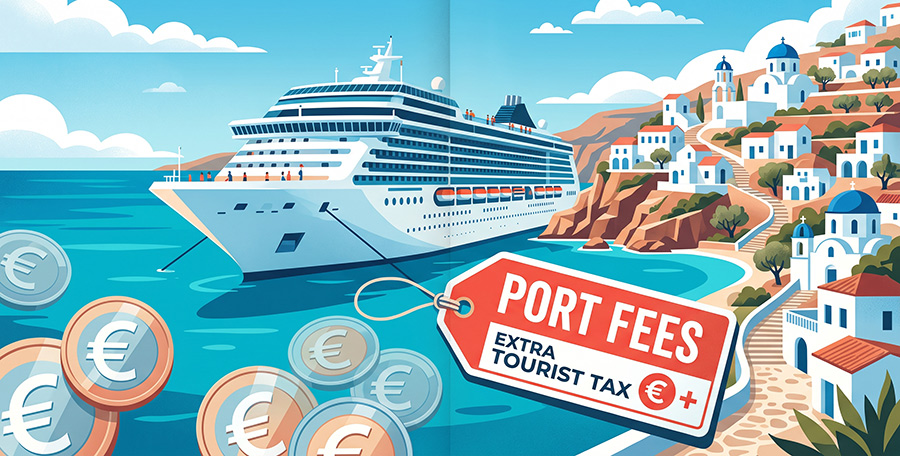
The fare is one thing, the final invoice another. In 2026 several of the most popular Mediterranean and North Sea ports raised their charges on cruise passengers or introduced new ones. Here is where it has become more expensive.
Greece: up to 20 euros per person
Santorini and Mykonos charge up to 20 euros per guest for coming ashore during the high season. Both islands are among the most overrun destinations in the Aegean, and the levy is explicitly intended as a steering instrument, not merely a source of revenue. Outside the peak months the amount is lower.
Santorini redistributes its visitors
For Santorini, 2026 brings a change that alters the shore day more noticeably than the amount does: a new distribution system requires up to 70 per cent of cruise passengers to land at the old port below Fira, with no more than 30 per cent allowed to use the port of Athinios.
That has consequences for planning on board. Landing at Fira means the cable car, the donkey path or a walk up — and with several ships in port at once, that is where the longest queues in the Aegean have always formed. Coming in via Athinios means the bus. Which route you take is no longer decided by the cruise line alone, but by the quota.
Amsterdam: 14 euros a day — and an open question of principle
Amsterdam levies a day-visitor tax of 14 euros per day on cruise passengers. More interesting than the amount is the direction of travel: the city administration has announced it will examine whether to end ocean cruising in Amsterdam altogether by 2035. That is not yet a decision, but it is a clear signal for anyone planning northern European itineraries in the long term.
Barcelona: higher taxes and fewer ships
Barcelona is tightening on several fronts at once: the tourist tax is going up, passenger numbers are being capped more strictly, and environmental requirements in the port are being sharpened. Part of the levy flows directly to the city. For the Mediterranean's largest cruise port this is a remarkable change of course — Barcelona spent decades as the port that pursued growth most actively.
Where these amounts sit in your fare
You will rarely pay any of these charges at the gangway. The usual arrangement is that the cruise line collects them and shows them under port fees or service charge. Two consequences follow:
- The advertised fare often does not include them. Check whether "incl. port fees" is genuinely stated.
- If the itinerary changes, the fees change too. If Santorini is dropped in favour of a smaller port, the amount can fall — but that correction rarely happens automatically.
What to check before booking
- Compare final prices, not headline prices. Two offers with the same base fare can differ by three-figure sums once the extras are counted, if the itineraries include ports of differing cost.
- Do the maths on Aegean itineraries. Two calls at Santorini and Mykonos add up to as much as 160 euros in landing charges alone for a family of four.
- Check for tender ports. Where passengers come ashore by boat, the shore day also depends on the weather. The fee is usually dropped then — along with the excursion.
If you want to check the calls on your itinerary in advance, you will find the ports with their sights, climate data and webcams in our port database.