Norway's 2026 fjord ban: what actually applies — and what was only a headline
For years the claim has circulated that from 2026 no cruise ship may enter Norway's World Heritage fjords. The rule does exist — but it affects almost none of the ships travellers actually book.
02. September 2026 ·
"Norway bans cruise ships from its World Heritage fjords in 2026" — this headline has been doing the rounds in travel forums and newsletters since 2018. In that form it is not true. Anyone booking a Norway cruise for 2026 or 2027 should know where the rule actually stands.
What was decided in 2018
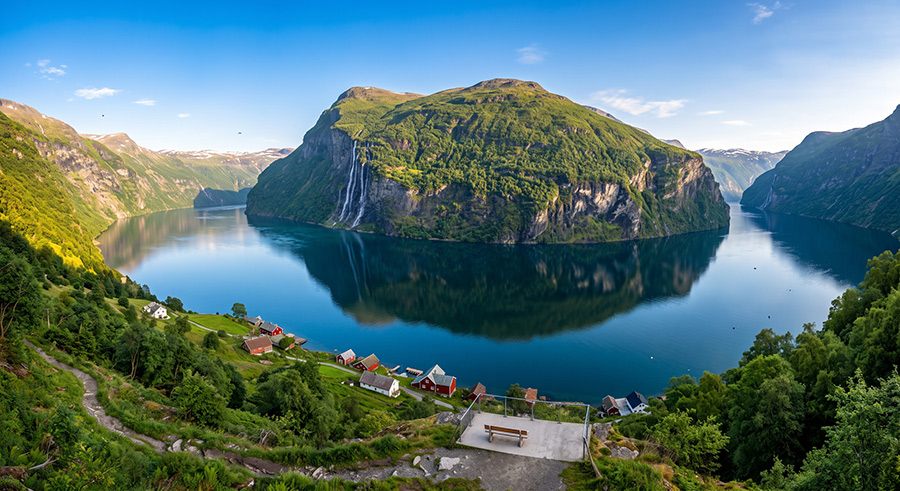
In 2018 the Norwegian parliament passed a far-reaching resolution: in the fjords that have held UNESCO World Heritage status since 2005, only emission-free vessels would be allowed from 2026. Five waterways are covered:
- Geirangerfjord — the best known, on almost every Norway itinerary
- Nærøyfjord — the narrowest, often sold as the highlight
- Aurlandsfjord — the fjord leading to Flåm
- Sunnylvsfjord — the approach to Geiranger
- Tafjord — partly covered
The resolution was meant seriously, and the industry took it seriously. The trouble is that emission-free ships of this size do not exist to this day.
The 2024 reversal
That is precisely where the deadline failed. In 2024 the Norwegian government softened the zero-emission requirement and drew a line that makes all the difference:
- Ships up to 10,000 GT — zero emissions have applied since 1 January 2026
- Ships above 10,000 GT — the obligation was postponed to 2032
The reasoning was that the technology simply would not be available for large ships by 2026. In practice this lifts the entire ocean-going fleet out of the rule. For scale: AIDAnova measures some 184,000 GT, and even the smaller Sphinx-class ships come in above 71,000. The 10,000 GT threshold catches expedition vessels, ferries and small excursion boats — not the ships most guests take on their fjord cruise.
Why biogas counts as emission-free
A second decision matters at least as much in practice: Norway recognises operation on biogas as emission-free. That is a political definition, not a physical one — burning biogas still produces CO₂ at the funnel, it simply does not come from fossil sources. For the smaller ships that are affected, this opens a route to keep calling at the fjords without switching to battery or hydrogen propulsion.
In parallel, the state is expanding shore power. In Flåm, one of the busiest fjord ports, the installation is due for completion in the second quarter of 2027. Ships will then be able to shut down their engines at the berth — which noticeably cuts noise and exhaust in the village, but has nothing to do with the passage through the fjord itself.
What our own data shows
We track the positions of the ships in our database around the clock. In the area of the Geirangerfjord we recorded position reports between 7 June and 23 August 2026 — from the MS Trollfjord of Hurtigruten, a ship of 16,140 GT with room for 648 guests.
The number before the decimal point is the interesting part: at 16,140 GT even this comparatively small ship sits well above the 10,000 GT threshold and therefore also falls under the deadline pushed back to 2032. It is a useful indication of how high the limit has been set relative to the real cruise fleet.
One caveat belongs here: our live tracking does not cover every ship without gaps, and in August our AIS data provider was down for eleven days. The record therefore proves which ships were there — it is not a complete register of every call.
What this means for your booking
For Norway cruises in the 2026 and 2027 seasons, the fjord rule changes nothing. Geiranger, Flåm and the Nærøyfjord remain on the schedules. If you see an offer advertising a "last chance before the ban", treat it with scepticism — that urgency is manufactured.
More relevant to your wallet are the rising port and visitor charges that Norwegian municipalities have been allowed to levy since 2026. They usually appear as port fees on the final invoice rather than in the advertised fare.
And 2032? That is six years away. Whether the deadline holds or is pushed back again depends on whether there are by then large ships capable of transiting a fjord with zero emissions. Today there are none.